RoboSwap: one arm, swappable tools
I want a lab robot that can move a plate, swap its gripper for a pipette, transfer liquid, and pick up the next tool it needs. That’s the idea behind RoboSwap: swappable end effectors—the tools attached to a robot arm.
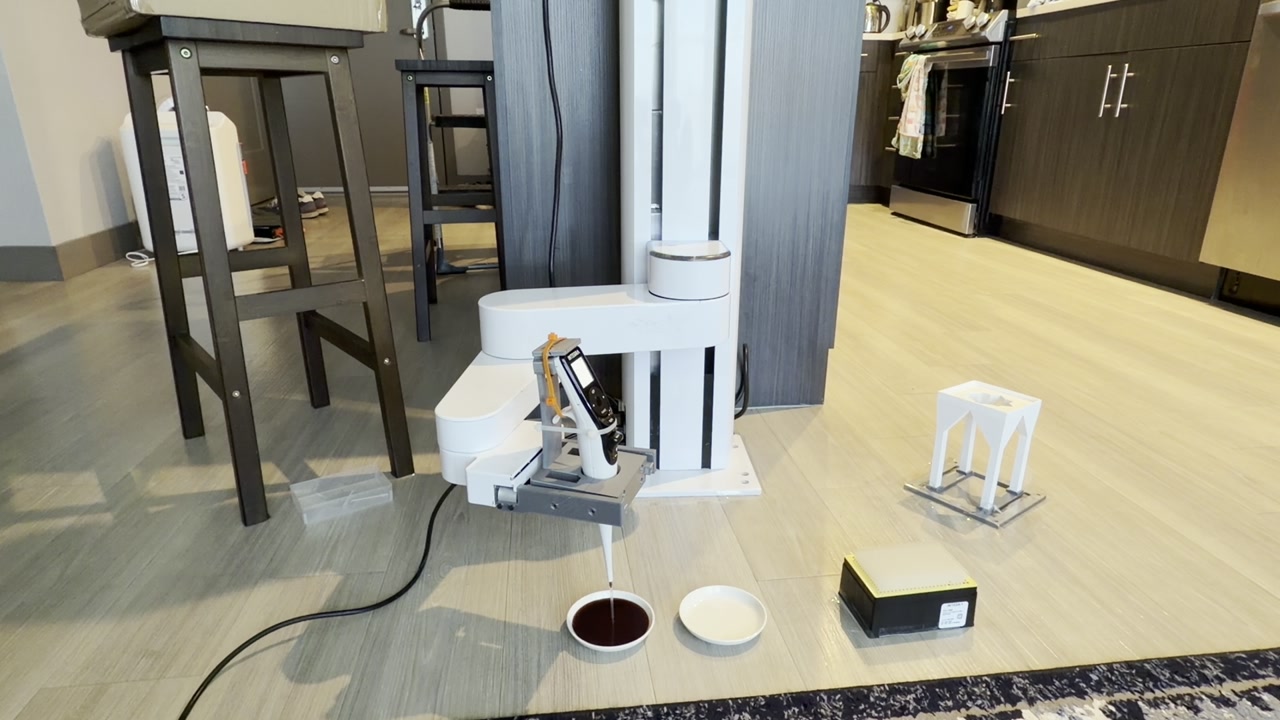
I built the first working prototype in one week, most of it spent waiting for my 3D printer to finish parts. I don’t have a lab, so I’m pipetting soy sauce between two saucers in my kitchen.

I built around the arm I had available, a PF400. I designed and printed a pipette harness, gripper fingers, and a stand, and reused robot-control code I’d already worked on. The gripper picks up the harness, which holds an INTEGRA VIAFLO electronic pipette. I control aspiration and dispensing over Bluetooth. Using an existing pipette let me concentrate on getting the robot to pick it up and use it.
This pipette doesn’t have automated tip ejection. My solution was to have the robot press the pipette’s ejector against a stool. That’s why the stool is there.

I also built a browser app to teach positions, put together a sequence, and preview it before running the robot. It models the same setup, right down to the saucers and stool.
The biggest opportunity I see is one workcell that can handle many workflows. With a flexible enough toolset, you shouldn’t need a dedicated workcell for every workflow. I’d like a lab to reuse the same setup for different experiments by changing tools and sequences. It could move plates and prepare dilutions, then switch to handling and capping tubes with the right tools.
That flexibility could also make workcells smaller. If the arm moving plates can also do the pipetting, some workflows could lose an entire separate instrument and its motion system. A compact tool rack could reduce both the footprint and the volume of the setup.
My immediate goal is a tool changer that reliably and automatically swaps between pipettes and grippers. The kitchen prototype picks up and uses one pipette. The full design needs a more suitable arm. My next milestone is a workflow that switches between moving plates and pipetting, with repeated tests of docking consistency and liquid-transfer accuracy.
The value comes from the flexibility of the end effector: a new tool gives the same arm another job. I’d start with grippers and pipettes of different volumes, then work toward cappers, decappers, and 96- and 384-channel pipetting heads. Those larger heads would need an arm that can handle their weight and tip-loading forces. Reliable tool swapping could open up many other applications in lab automation, including tools built by other people.
Long term, I want to replace as many functions of giant, boxy liquid handlers as possible. It’s a multibillion-dollar industry, and I think more of those functions could fit on a shared arm. A lab could start with a gripper and a pipette, then add tools for new protocols. That’s what I want to build toward: a workcell you can keep using as the work changes.